Sunday, August 2, 2009

Cooling Off: A Look Back

Only a few days ago I finished saying Kaddish, and today was the day my mother would have turned 56. In a few weeks the family will gather in Chicago for the unveiling of her gravestone. I feel almost as if this is the triathlon of grieving that we’ve all been preparing for all year. Within a few weeks, everything rushes to the surface, and then, on Friday night August 28th I light a yahrzeit candle, and say Kaddish, and it’s over.

I’ve been wondering a lot about what I’ll take away from this year. My last blog post struck a chord with a lot of people, I think, and I got a lot of phone calls and emails from old friends and strangers who wanted to check in and said all kinds of nice things. As I was reading the emails earlier today it struck me that the number one lesson I’ve learned about this stuff is that it’s always better to acknowledge someone else’s grief than to ignore it out of fear of saying something inappropriate. Maybe this is petty, but there are some people who never got in touch with me after my mom died, and though I’m almost certain it’s because they were worried about saying the wrong thing or just repeating clichés, their absence is something I will never forget, and may never be able to get past. When people who I wasn’t really in touch with anymore made contact to tell me they had heard and were sorry, it was really powerful. People showed up at our house during shiva who I never got to speak to because there were so many people there, but just seeing that they made it was really important to me.

Shortly after I moved to Nashville I went on a date with someone who I didn’t know very well. While we were out he told me that his father had died a few months earlier, and he was visibly upset about it. Later on he brought it up again. And I remember thinking it was kind of inappropriate that he was bringing it up, and—this really makes me cringe—I remember so vividly thinking he should just get over it. I don’t think I even said anything to him about being sorry. I have thought back to that moment literally hundreds of times since then, and my regret is just—well, monumental doesn’t really cover it.

The way that cancer (or any disease, I’m sure, but my experience is with cancer) can devastate a family is something most people my age haven’t dealt with, and I do think there’s something about being in our situation that you really can’t comprehend until you’re in it, too. But I don’t think that matters as much as people say it does. Even if you can’t sympathize you can empathize. You can just say, “I’m really sorry this crappiness is happening to you.” The difficult part is really getting over yourself to the degree that you’re going to be comfortable either repeating a cliché, which is almost unavoidable, or risking saying something stupid and/or hurtful. Acknowledging someone else’s grief is more important than feeling good about yourself. Keep repeating that until you believe it.

The other thing that’s been on my mind today is a very specific feeling of dread. My mother died when she was 55, almost exactly a year after she was diagnosed with cancer. She was the fourth woman in three generations of her family to be diagnosed with breast cancer. It seems inevitable then that breast cancer will again be a major presence in my life, likely only 25-30 years down the line.

It’s hard to convey what it’s like to walk around all day feeling like you have a ticking bomb strapped to your chest. In a very weird way, I find it almost reassuring. If my fate has been set, then I really better get to work to accomplish what I want to accomplish in my life. It’s sad, of course, but in a very abstract way. It’s also frightening. But more than anything I feel this dread that I used to feel before exams, or conversations that I knew weren’t going to go well. I feel like my breasts have said to me, “We need to talk.” But we’re not actually going to break up until I’m in my fifties. Because however it happens—to my sisters, or my cousins, or me—I just know that it’s going to be bad. (Please spare me the talk on how everything is going to be cured in 25 years. I don’t buy it.)

I think a lot of my trauma this year has been related to knowing that even though the rest of my life is probably not going to be as hard as these past two years but that at some point I will be dealing with similar issues. I want a get out of cancer free card. I want to know that this won’t be chasing me for the rest of my life, but that’s just not an option.

Life is hard, is what I’m saying. I know that’s not a secret, but it’s something I didn’t take very seriously until cancer became a part of my life. And now, every day it’s a new revelation. This is hard. I am ready for it to get easier.

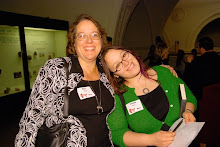
(The photo is my mother on mother's day a few years ago. My cousin Abigail is in the foreground. Photo courtesy of my cousin Joe Nicholson.)

Wednesday, July 29, 2009

Ending Kaddish on Tisha B'Av

In a few hours we begin mourning the destruction of the Temple. Tisha B'Av is considered the saddest day of the Jewish year, and this year it also marks exactly eleven months from the day my mother died. Tisha B'Av is the last day I'll be saying Kaddish.

This is the part where I would like to be writing something about healing and powerful the experience of saying Kaddish has been. I'd love to have something beautiful to say about being embraced by tradition, and finding myself truly invested in it in a way I never had been before. I could say something about moving forward, about treasuring the past while moving towards a life of future happiness… but that would all be complete and utter bullshit.eema_pesach.jpg

So many calamities happened to the Jewish people during the month of Av, that the Mishnah famously warns Jews from conducting any legal trials during this saddest of months, because during Av the verdict is sure to come out against us. This is somewhat enigmatic--one might expect the rabbis to try to paint the day in a more positive light and make some kind of statement about redemption coming eventually. But no, Tisha B'Av is set aside as a day to mourn for the past of the People of Israel--for everything we had that was destroyed or taken away from us. The insistence on sadness is so great that even studying Torah, that greatest of mitzvot, is prohibited (with a few depressing exceptions) on Tisha B'Av, lest we derive too much pleasure from our studies and forget the somber mood of the day.

I find all of this focus on sadness both satisfying and unjust. On the one hand, I fully appreciate the ability to spend tomorrow moping around feeling generally miserable, bitter, and forlorn. I'm pretty sure I have perfected miserable, bitter, and forlorn this year, and as I enter into the final formal stages of mourning for my mother, it is nice to be allowed--required, even--to focus on just how appalling the last two years have been. Conversely, I'm a little peeved that Tisha B'Av has taken the specialness of this moment from me. My last day of saying Kaddish was when I wanted to stand up in my community and have one last chance to show people that there are young people mourning amongst us. Selfishly, I wanted the attention, the hugs, the sympathy that many people get on their final day saying Kaddish. And I won't get that, because everyone else at minyan will be absorbed in their own thoughts of misery, persecution and pain in Jewish history.

This is all a nice little microcosm for how I've felt all year. I appreciate some of what traditional Jewish mourning practices seem to be saying and teaching, but ultimately, I find myself let down by the rituals and communities I had hoped I would find comforting. It has been eleven months of saying Kaddish, and I do not feel healed.

When my mom was sick I remember telling people I felt like I was falling apart, and I used to picture myself literally falling apart, limbs tumbling off of my torso. I was so upset all the time, I remember thinking things could not possibly get worse. On mornings when I held my mother as she writhed in pain, and at one point actually asked me to call my sisters so she could say goodbye to them, I remember thinking--it cannot get any worse than this. This is the hardest thing I will ever do. But I was almost laughably wrong. The days since my mother died have been thousands of times harder than the days that she was dying.

I had this vision of getting into a routine after my mother died. I thought I would find comfort in the day to day things, and that I would slowly begin to feel better. But the horrifying truth is that there was no routine to fall into without my mother. In the months after my mother died I felt as if my life exploded. I was no longer falling apart myself--instead, everything around me seemed to have gone psychotic. People who I loved and who had been supportive where suddenly hurtful, rude, or noticeably absent. Traditions--both religious and family--disappeared, or were transformed into grotesque acts that only demonstrated just how bizarre life could be.

The plain truth is that I have never felt more abandoned than I did this year. By my faith, by my community, by my family and friends. Even by my mother.

Tuesday, June 16, 2009

"The Dead" and Saying Kaddish Alone

Last night was the kickoff event for this summer's fellows at Yeshivat Hadar. It was a great event, with some wonderful study sessions and warm welcomes from a number of rabbis and guests. At the end of the event we davened Maariv, and though there were well over a hundred guests from a variety of age brackets, I happened to be the only person saying Kaddish.

This happens more rarely than I would expect. In the morning I tend to daven Shacharit at a Conservative shul where more than half of the crowd is in avelut. For mincha and maariv I'm usually at Orthodox shuls with a decent sized crowd, and at least a handful of guys saying Kaddish. But on Shabbat at Kehilat Hadar, and last night, and the yeshiva's inauguration, it's just me.eema_stroytelling.jpg

There is something terrifying and horribly sad about this. It is an inescapable moment of declaring my grief to a room full of people, many of them strangers. Though I've come to have a grim familiarity with my misery this year, rarely do I feel the words of Kaddish really move me. Their meaning is infamously not about death or bereavement, and the Aramaic, though familiar to me in some ways, still sets up a barrier between my recitation and a true internalization of what I'm saying. But when I am speaking alone, the words loom huge and intimidating before me. The responsibility seems heavier, more poignant, when there's no one else around in similar straits.

It is at moments like this that I miss my mother the most. She had many talents, but making people feel less alone, whether that was through welcoming people into our home, visiting the sick, or generally reaching out to people she knew were having a hard time, was an area where she was noticeably effective and strong. Walking home last night I thought about how much I wished I could call her and tell her how hard this year of saying Kaddish has been, and how disappointed I've been in my own traditions.

In a way, it's good to have these startling and solitary Kaddish experiences every once and a while, because they infuse the experience with a meaning that I often feel is missing. But then, when those moments arrive it is shockingly overwhelming. One moment I'm fine, and the next I'm drowning in this feeling of being totally alone and set apart from a room full of people.
We all have this feeling every once in a while, it's not exclusive to grief, but it's one that I think we feel more acutely when we are grieving.

In James Joyce's famous short story "The Dead" the protagonist, Gabriel, finds out at the end of the story that his wife Gretta was in love with a young man who died many years before. Gretta is reminded of her old love because of a song she hears at a party she and Gabriel attend together. Just as they are leaving the party one of the guests begins to sing The Lass of Aughrim, and Gretta suddenly gets a gleam in her eye, and color in her cheeks. Gabriel thinks she's in the mood for love, but back at their hotel he finds out she was grieving, thinking about her old beau, Michael Furey.

The story focuses on Gabriel and his experience, but this morning I reread and for the first time sympathized with Gretta. The Lass of Aughrim was her Kaddish, and there she was at a party and suddenly this song comes up and she's the only one in the room who knows how meaningful it is.

Joyce doesn't seem particularly interested in Gretta at the end of The Dead. He focuses on Gabriel, who has this sudden moment of realizing how insignificant he is and can be in the world. All night he's been singularly self-absorbed, and then he hears this story about his wife's past and he realizes that it's not all about him--that other people have loved and lost while he was mired in his own world. In the penultimate paragraph Joyce writes, "His soul had approached that region where dwell the vast hosts of the dead. He was conscious of, but could not apprehend, their wayward and flickering existence. His own identity was fading out into a grey impalpable world: the solid world itself, which these dead had one time reared and lived in, was dissolving and dwindling."

Though I dread the moments of being the only person in the room who is saying Kaddish, I also hope that by standing up there alone, saying the ancient words that mean my mother is gone, that there's someone sitting in the room who is shocked into thinking about all the devastating losses that everyone experiences all over the world. I hope someone is inspired to be a bit more sympathetic, to a deeper level of perspective and compassion. Because as the year wears on I've become more and more aware of how much loss is stacked up around us every day, and how each of us has suffered in ways no one else will really understand.

Friday, May 8, 2009

Happy Second Passover! I Call a Life Do-Over

Today is Pesach Sheni, or Second Passover, a day ordained by the Bible as the silver medal for those who can't win the Passover gold.

Basically, on Passover God commanded the people to offer a paschal sacrifice. Pretty simple. But what about the guys who happened to be impure on the first day of Passover, because they had been in contact with a corpse, and thus weren't allowed to offer a sacrifice? Were they just SOL? Nope. The guys went to Moses and asked how they could fulfill the mitzvah, and Moses asked God, and God said they should just come back in a month and make their sacrifice then. That day a month later is Pesach Sheni. Yay, hooray, everyone gets to make their paschal sacrifice. rhonda_and_eema.jpg

Some people think of Pesach Sheni as a symbol of second chances, of opportunities to do things over that we didn't do really well to begin with. If, for some reason, Passover didn't feel particularly redemptive this year, today is the day to give it another shot. Eat a piece of matzah and some bitter herbs. Think about the exodus.

Weirdly, Pesach Sheni is prescient for me this year. I didn't feel redeemed over Passover this year. I felt oppressed and sad and more than a little whingy. And guess what I'm doing today, on Pesach sheni? Going to sit with a family whose mother is in hospice.

The woman who is dying was close friends with my mother, and is suffering from the same thing that killed my mother. She has two daughters, one who's my older sister's age, and one who's my age. She worked in Jewish education (like my mother) and she's no longer awake. I'm going back to Chicago to say goodbye to her, and to sit with her family, and yesterday in the grocery store I had this sudden and random thought about what I want to say to this woman when I see her lying in bed. I don't know that she'll be able to hear me, but I want to tell her how important her life was to so many pre-schoolers whose lives she changed at school. How much I used to love going over to her house to eat her famous pudding pie. How impressed I am at how long and hard she fought her cancer diagnosis. How grateful I am for all of the support she gave my mother. And also--and this is where I started crying in the grocery store--I want to tell her that if/when she sees my mother I need her to tell my mother that I miss her every day, pretty much every minute. That I have a million questions for her. That I love her so much. That I should have said that a lot more often.

I guess it kind of is a day of second chances.

(Cross-posted at Mixed Multitudes)

Sunday, April 19, 2009

Feeling Sorry For Myself

I am a champion whiner, but even I have to admit that there comes a time when we each need to stop feeling sorry for ourselves, stop complaining, and get back to the business of living. I often find myself looking forward to that point in the midst of a crisis. Yes, there’s some appeal to wallowing in one’s sorrow, and allowing oneself to maintain a certain sense of misery when bad times seem to be the rule, and not the exception, but I find that I hit my threshold after about twelve hours, and then, ideally, I would like to go on to some task that I can focus on instead of my own shitty situation.

This year has afforded me many more opportunities to wallow than I’m really comfortable with. It seems that every week or two there is some enormous issue that saps 90% of my mental energy, and gives me another reason to feel sorry for myself. My grandmother died a few weeks ago, shortly before that my sisters and I found out some news that upset us. Since then we’ve celebrated Pesach without my mother, and found out about a number of deaths and illnesses in our community, as well as upcoming simchas among our community and friends. Even good things are still tinged with this sense of strangeness, a foreign and empty feeling I’ve come to know as I go through life constantly thinking about how my mother would have reacted to a piece of news or a major historical event.

It’s not difficult to imagine what my mother would have said about most of these things. I knew her very well, of course, but these have tended to be events to which there isn’t likely to be a variety of responses. She would have been sad to hear that some of our friends are sick, and would have mourned my grandmother's death. She would have grinned and hugged those who are engaged, married and expecting babies. But knowing what she would have thought and said is no consolation at all. The reason we have friends and the reason we cling to our families is not to hear the words we all expect at happy and sad occasions, it’s to feel, somehow, that both joy and pain are being shared by those we love. We want to see our own feelings mirrored in others because it lightens our load when we’re downtrodden, and increases our joy when we’re happy. When my mother died, I lost perhaps the biggest and most important mirror in my life. She was the person that so many of us went to when we wanted sympathy, pride, love, acceptance and even grief reflected back at us. And like all good mirrors, though she most often reflected back what you already knew or thought, she was unafraid to tell people when they were being unreasonable, and needed to shape up.

I think about this idea often as I say Kaddish at minyan, because I am not at all sure how my mother would have reacted to my frustrations and the theological confusion I now feel about saying this mourning prayer. I remember one or two conversations we had about her own experiences saying Kaddish for her father, but I was 14 at the time, and didn’t have any concept of what the experience would be like for an adult. I still don’t think I have a concept of what it’s like to say Kaddish when you’re in your forties and fifties. So I don’t know what she would have said if I would have told her that I find myself resenting going to shul, bored and angry during most services. Would she have shared my frustrations, or would she have reminded me of the history and significance of the Kaddish through centuries of Jewish life, and of her own commitment when her father died? I can see either. Or actually, neither.

I feel sorry for myself, again.

[The photo is of me and my mom when I was about eight years old. I chose it because I think we look so much like each other—mirror images, if you will.]

Cross-posted at Mixed Multitudes.

Friday, February 27, 2009

Life Used to be Normal

A year ago today I had a fairly normal day. I had lunch with my friend Jaya. I went to a yoga class and had a writing workshop and things were basically fine. My mom had just finished chemo for her breast cancer, but the doctors had told us that once she was done with that the chances of the cancer ever coming back were 3%. Though I was concerned that the drugs seemed to have done a serious number on my mother, giving her endless headaches, and leaving her feeling weak and constantly tired, I was very glad it was over, and unconcerned about a relapse, seduced by that magical 3%.eema_in_jerusalem.jpg

That was the last normal day of my life. The next morning my dad called me at about 6:30 in the morning from the hospital. Over dinner the night before my mom had had a seizure, and my father had rushed her to an emergency room. Overnight she'd undergone a series of tests that revealed the cancer had spread to her brain, where it was spotting the gray matter and putting pressure on her brain causing the headaches, and ultimately the seizures.

It's a bizarre thing, realizing how quickly life can change. One minute you're eating dinner, the next minute you're dying. One minute you're lying in bed, the next your life is crashing down around you.

I spent most of that first day of not-normal life holed up in my apartment with a good friend. I remember I kept checking the news, as if expecting to see my mother's diagnosis splashed across the headlines. I spoke with various members of the family all day, all of us traumatized, confused, disoriented. That was the beginning of six months of lessons in how quickly things can change. In meeting after meeting with doctors we got new and always astounding information. The cancer spread inconceivably quickly, and as soon as we finished treatment for one issue, a new one cropped up. Finally, there was the ultimate change, from life to death.

One of the things that I often think about when I'm struggling with saying Kaddish is how is provides a sense of stability in this year. Many things are still changing in my life, but there is a constant running through my days. It's not a fun constant, and I haven't found it to be healing in the way that many people have told me they find Kaddish to be healing, but it provides a rhythm to my life now that I didn't have before.

Still, I'd take a hundred more years of changes for five more minutes with my mom.

Friday, February 13, 2009

Member of the Tribe

Recently, a friend’s father died suddenly, and I found out a few days later through a mass email that one of her friends sent around. Reading about it, I felt like I was being punched in the gut. Another one of my friends joining the horrible club of those saying Kaddish, and mourning a parent at a young age. The minyan I attend most mornings has gotten a few recent additions because of a death in the community, and children who have joined us for their year of avelut. One of the newest faces at shacharit is only a few years older than me. I haven’t been able to look him in the eye yet.

I have always been fiercely protective of my friends (something I certainly learned from my mother) and in the face of grief, though I know I’m powerless, I still want to somehow cover these people in a bubble of safety and tranquility. (This is a concept not foreign to Jewish ideology. At Ma’ariv we ask god to ‘spread over us Your shelter of peace…shield us from enemies and pestilence, from starvation, sword and sorrow’ (u’fros aleinu sukkat shlomekha…v’haser m’aleinu oyev, dever, v’herev v’ra’av v’yagon.)EemainLondon.jpg

While I was sitting shiva a friend of mine (whose own father had died only six months earlier) came to be with me, and memorably stood right in front of me with arms crossed, looking appropriately menacing, so as to dissuade people from coming over to make me cry any more than I already was. I wish I could do the same for all of my friends who are suddenly in this situation. I’d like to be there, physically, to protect them, but metaphysically, too. I think constantly about building some kind of magical force field that would prevent others from joining this miserable community.

And then there are the surreal moments where I am grateful for my horrible lot. Sometimes this comes while hearing about others going through struggles that are far more terrible and heartbreaking than mine. Young mothers who die suddenly, leaving infants, those with missing children, or babies undergoing grueling and unsuccessful treatment for cancer and other diseases. It’s true when they say that it could always be worth, and I do, somewhat grotesquely, feel lucky to have had the opportunity to say goodbye to my mother, to hold her hand while she slipped away from us, to care from her in the months leading up to her death. More often than not, though, when I find myself feeling grateful it’s because I have somehow been given access to this community of strong young people, who are able, despite horrible circumstances, to go on and build lives of success and happiness. People who are compassionate beyond their years, who are good listeners, and deep thinkers, and care for others in a way that embodies grace and love. Given the option, I would still wish to be ignorant of these people, to live without this all-encompassing grief. But if I have to be here, I’m so glad to be surrounded with good company.

(The photo is from a family trip to England in 1988. I was 3, Deena was 6, and Renana was in utero.)